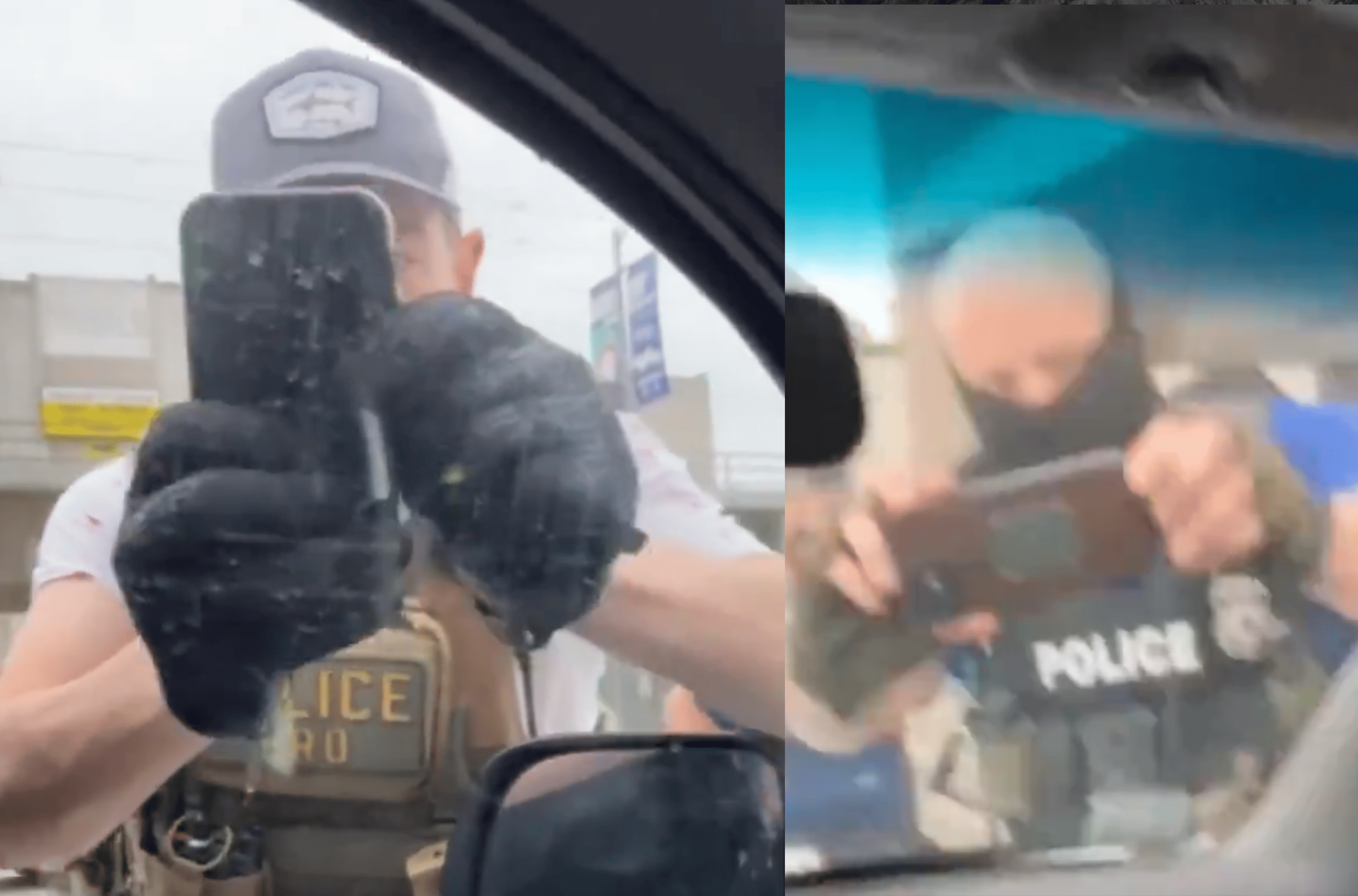
 Screenshots from video posted by Chad Loder on Bluesky
Since Trump's second term started, immigration control in the United States has operated under a new logic: the transition from physical patrols to algorithmic surveillance. Through tools like the Mobile Fortify app, U.S. Immigration and Customs Enforcement (ICE) has institutionalized real-time biometric profiling. Therefore, as recent documents from the Department of Homeland Security (DHS) show, this technological innovation is not merely an operational improvement, but an instrument for violating basic civil rights, with a disproportionate impact on the Latino population.
The central point of the discussion lies in the mandatory nature of facial scanning. As reported, ICE guidelines establish that individuals in custody or under search do not have the right to refuse biometric capture. This imposition transforms the agent's smartphone into a field forensic tool, capable of instantly cross-referencing images with vast federal databases. By removing the possibility of consent, the State converts the immigrant's face into permanent and unquestionable evidence, eliminating any sphere of privacy in public space and consolidating what has been characterized as "total capture."
This monitoring infrastructure is fueled by integration with large-scale analytical systems, such as Palantir Technologies' Elite software. While Mobile Fortify acts on individual capture, Elite processes data of public utility, such as address records and energy consumption, to perform predictive policing. Thus, this union between the government and technology companies constitutes a kind of surveillance industrial complex. The result is the automation of repression, in which algorithms define "target neighborhoods" and optimize location definition and capture, transforming districts with the presence of immigrants into zones of intensive monitoring under a justification of technical efficiency that masks racial profiling.
Finally, the socio-racial implications of this "precision surveillance" are profound. In addition to technological vulnerability, given the high error rate in facial recognition algorithms for non-white populations, the systematic use of these tools generates a chilling effect. When community routines, such as going to work or school, are mediated by the risk of mandatory scanning, the disarticulation of social support networks occurs.
Migratory exclusion, therefore, now manifests itself digitally: an
invisible but omnipresent barrier that criminalizes movement and imposes a
state of perpetual surveillance on the Latino body in the United States.