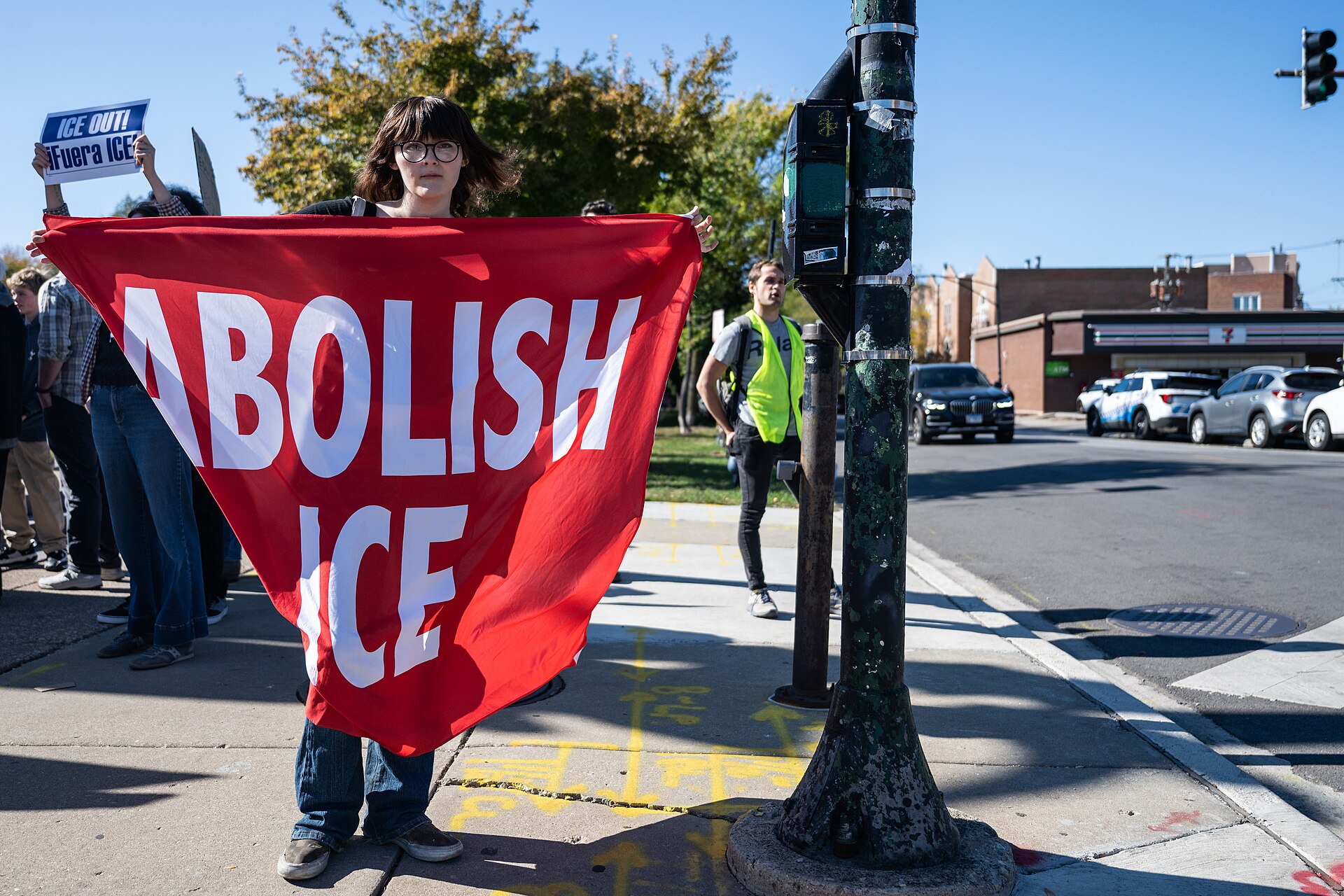
 Paul Goyette from Chicago, USA
Donald Trump’s second term is unfolding in 2026 amidst major changes in the United States, particularly regarding immigration and the economy. Elected on a promise to carry out mass deportations and secure the nation's borders, the president has been utilizing ICE (Immigration and Customs Enforcement) - the government agency responsible for immigration control - to implement his policies. Since January 2025, the country has witnessed a widespread increase in the agency's enforcement and search operations, targeting regions with high immigration rates - such as Democratic-leaning states - in particular. Beyond sparking political and social alarm, the intensification of ICE operations has led to a curious outcome: a decline in available jobs. According to a new report by the Brookings Institution, the ramping up of anti-immigration enforcement has cost the country 668,000 jobs, particularly in areas with significant economic activity.
Consequently, it is important to analyze how this new reality is reshaping not only American society but also the nation's economic capacity.
An analysis of the effects of ICE operations reveals a significant drop in consumer spending in areas where the agency focuses its efforts. According to Professor Zeke Hernandez, a researcher at UPENN Wharton, a study combining 5,000 ICE operations with "Points of Interest" (locations targeted by the agency) showed a decrease of 8 billion visits and a loss of between $3 billion and $14 billion in domestic consumption. In other words, considering the job losses resulting from reduced consumption and fewer visits to public spaces - such as retail or business districts - one can discern the impact of Trump’s measures on the national economy.
Furthermore, as previously mentioned, the geography of these locations reveals that ICE operations are concentrated primarily in densely populated, politically Democratic regions. An examination of where most ICE arrests occur reveals a pattern of activity in cities such as New York, Los Angeles, San Francisco, Portland, Chicago, Seattle, and other major urban centers. Beyond their immense economic and political influence, many of these cities are notable for their immigrant-friendly policies. In the New York metropolitan area - which encompasses other parts of New York State - Latinos accounted for approximately 93% of ICE arrests. Against this backdrop, a link can be drawn between the intensification of ICE initiatives and a decline in economic activity in specific regions of the United States. There is also a noticeable rise in arrests within major cities, specifically targeting the Latino population.
So, how might these ICE initiatives affect the U.S. economy in the coming months, given the country's struggle with rising inflation and a degree of consumer wariness? To answer this, one must look at where the impact of ICE’s actions was felt most immediately: the productive sectors that form the backbone of the U.S. economy - specifically construction, agriculture, and hospitality (industries historically reliant on immigrant labor) - which were the first to register the effects of stepped-up enforcement.
According to the American Immigration Council, the agricultural sector lost 155,000 workers between March and July 2025 - a period during which the sector had grown by 2.2% the previous year. In the hospitality industry, workforce growth was just 0.2% in June 2025, compared to 1.5% in the same month of 2024. The picture was no different in construction: a survey by the Associated General Contractors of America revealed that 88% of companies in the sector reported job vacancies, with nearly 30% citing immigration enforcement as a direct factor in their hiring difficulties.
However, the impact is not limited to the figures mentioned above. In Minnesota, a builder told CNN that his roofing crew shrank from 80 workers to just six while ICE agents were operating nearby - an operational collapse caused not by deportations, but by the fear of leaving home. In California, operations in Oxnard halted the harvesting of strawberries, broccoli, and celery, leading to projected direct losses of between $3 billion and $7 billion for the state's agricultural sector, with an estimated multiplier effect of $5 billion to $10 billion when packaging, transportation, and retail supply chains are factored in. The narrative that removing immigrant workers would open up opportunities for native-born Americans also failed to hold up in practice: researchers at the University of Colorado Boulder found no evidence of increased job opportunities for U.S.-born workers in the regions affected by enforcement actions; on the contrary, on average, 1.3% fewer American men with a high school education or less were employed in those same regions following an ICE enforcement wave.
Part of the explanation for these figures lies in a phenomenon that extends beyond the direct removal of workers through government actions: the so-called "chilling effect." This refers to the spontaneous withdrawal of entire communities in the face of a climate of fear generated by these enforcement actions, and it is now evident that the scope of this effect is far wider than previously realized. According to the public policy non-profit Brookings Institution, concerns regarding detention rose from 33% to 50% among immigrants with legal status in the country and from 12% to 31% among naturalized citizens. What ICE operations produced, therefore, was not merely the withdrawal of documented workers from the labor market, but a retreat within entire communities: legal immigrants stopped going to work, families cut back on spending, and the resulting impact on whole neighborhoods led to reduced economic activity. It is evident that this effect rippled out to unexpected sectors: a study by the influential think tank "New America" revealed that the rise in ICE arrests resulted in a loss of 39,000 immigrant workers in the childcare sector and, consequently, forced 77,000 native-born American mothers to leave their jobs due to a lack of childcare. One of the study's authors, economist Chris Herbst, explains that "what these policies do is create a general climate of fear and confusion that affects people's lives to such an extent that they stop going to work and stop taking their children to school." The paradox is clear: a policy aimed at the undocumented ended up driving the very profile of American worker the government sought to protect out of the labor market.
An important point to note is that the geography of these operations is not neutral either. An analysis by the UCLA Luskin School of Public Affairs revealed that Latinos accounted for nine out of every ten ICE arrests during the first six months of 2025, regardless of nationality. Detentions of individuals of Venezuelan origin rose by 361%, while community arrests - those carried out on streets, in schools, and in stores - increased by 255%. In September 2025, the Supreme Court itself authorized the use of race as a factor in immigration enforcement stops, prompting Justice Sonia Sotomayor to state in her dissent that the ruling risked relegating Latinos to second-class citizenship.
The geographic distribution reinforces this pattern, as operations are concentrated precisely in the country's major economic hubs - the same urban centers that generate the largest share of the national GDP and are home to the largest Latino populations and the most immigrant-friendly policies. Enforcement efforts, therefore, do not merely target a specific ethnic group; they are most intense exactly where the economic impact will be greatest.
And who is on the other side of the coin? That is, who profits from these measures? While the broader economy contracted, one specific sector thrived. Companies holding ICE contracts for detention, surveillance, and logistics posted record results throughout 2025. The GEO Group, one of the country's largest private prison operators, described the year as "the most successful in its history in terms of new business wins," reporting total revenue of $2.63 billion. CoreCivic - now the largest private operator of detention centers in the United States - saw its profits surge by nearly 70% year-over-year. In the technology sector, Palantir - an American software company serving as the "brain" behind military, surveillance, and logistics operations - secured a $30 million contract to develop ImmigrationOS (an immigrant tracking system), while its stock price climbed 135% between late 2024 and December 2025.
The picture that emerges is one of wealth redistribution rather than value creation. While 668,000 jobs vanished from the economy, billions in public funds were funneled to private companies - many with a history of lobbying the very government agencies that hired them. The fundamental question remains: who, ultimately, was this immigration enforcement policy designed to benefit? Data from the U.S. Department of Agriculture (USDA) from June 2026 show that fresh vegetable prices are 11.9% higher than in May, with a projected 7.7% annual increase in the prices of farm and produce items. Meanwhile, in the housing sector, the Roosevelt Institute - which advocates for policy reforms to reshape the U.S. economy and democracy along progressive lines - notes that the combination of a construction labor shortage and new tariffs on raw materials has driven up building costs, exacerbating a housing crisis that was already severe prior to the deportations. From this economic perspective, the Congressional Budget Office found that GDP growth in 2026 is "partially offset by the effects of tariffs and increased immigration enforcement" - meaning that while the U.S. economy is growing this year, that expansion would be even greater were it not for the negative impacts of certain policies implemented by the Trump administration. Two of these stand out: first, higher tariffs drive up the cost of imported goods and inputs, fueling inflation and potentially reducing household purchasing power, thereby dampening consumption and, consequently, the pace of GDP growth. Second, the crackdown on immigration reduces the available labor supply, limiting companies' hiring capacity and productivity growth.
The political paradox is hard to ignore. The platform that promised to lower the cost of living and protect American workers has generated shortages in the sectors driving inflation (food, housing, and services) while concentrating gains among private detention and surveillance companies. According to the consultancy Deloitte, real household consumption is projected to slow from 2.7% in 2025 to 2.1% in 2026, with a decline in immigration specifically cited as a contributing factor.
We conclude that the data reveals not merely a flawed policy, but one
that works perfectly for those it was designed to benefit. While American
workers lose jobs, immigrant families retreat in fear, and entire economic
sectors contract, billion-dollar contracts continue to be signed, stock prices
rise, and reported profits are celebrated. In practice, the promise to protect
the American worker has resulted in a massive transfer of wealth - one of the
largest in recent U.S. history - from the country's productive base to private
corporations. ICE is not just deporting people; it is expelling the silent
engine that drives the American economy.